So several posts ago, I wrote about being an HSP and how I'd been attending a support group every week to help me manage my sensitivity, which has been one of the best decisions I've ever made. I also mentioned that I found the group on Meetup, and a part of it being a Meetup group is that new people are constantly joining. I would say that I'm one of about five regular attendees, and the rest have either been to a meeting before but don't attend regularly, or they're brand new. By now the routine of the group has changed (we've gone from weekly to monthly), but the core group remains.
It is truly very fascinating to see some of the new people who show up sometimes. Some are HSP, some aren't but they identify with some sort of social sensitivity, and some just show up to "check out the networking". One night, we had one of those "networking" type people show up, and while I was very overwhelmed by a lot of the information they provided, one thing they brought up really stuck with me:
They asked what love looks like to us.
It was a rhetorical question, meant to make us think and answer the question for ourselves, and that is exactly what it did.
I was very pensive the rest of the group, on the way home, and after I got home as well. I'd truly never thought about it before. I can obviously recognize love, but if someone were to ask me the best way to show me that they love me, I wouldn't have been able to answer them.
What does love look like to me?
I thought about all of the people who I feel love me the most-- which is to say, the people who make me feel the most loved, not that they truly love me more than all others.
I started with Patrick, and I thought about all of the moments where I feel most loved by him. For example, that morning I woke up from a terrible nightmare in which he died. I yelled myself awake, immediately went to find him, and he comforted me. I tried to go back to sleep afterward but I was still anxious, so I went out to find him again. This time he got up from what he was doing for work, spent as much time as was needed to make sure I felt safe and comforted, and then made sure that I was calm enough to get some more sleep by coming into our bedroom and checking the window shades, the blankets, and just overall making sure my space was comfortable. He didn't view me as an inconvenience for taking him away from his work or being emotionally needy. He saw that I needed something and provided it for me by going above and beyond, while at the same time never making me feel like I was being over the top, whiny, childish, etc.
When I woke up eventually (much later than I intended, but hey, nightmares don't really respect your timelines), I came out into the living room to find three gifts that he'd taken the time to wrap up (with Christmas paper, bless him). Why? He had ordered an add-on item from Amazon (which cannot be ordered by itself) and instead of ordering something for himself, he decided to go through my lists to see if there was anything I needed. So I woke up to a pair of gel moisturizing socks (which are INCREDIBLE), a boiled egg slicer, and a package of cable ties.
But why did he buy me things instead of something for himself? Because I'd been cleaning and organizing because we had a house guest, and he had seen how stressed out I'd been. It was a sweet gesture by itself, but then he went above and beyond to make the day feel like a mini-Christmas by wrapping up the items.
After I came home from group, I showered and kept thinking about what it means to me to be loved, and I thought about one of the most powerful things that anyone has ever said to me: "You're a priority."
I know that to some people that seems obvious, or small, or insignificant, but to me to be a priority to someone is an honor. To me, it means that I add something so valuable to their life that they rate me higher than most things.
But what does all of that mean? Well, let's simplify it. Society deems "useful" people as people who can perform a task or a service. A lawyer is useful for their knowledge of the law. An architect is useful for their ability to plan out and create buildings. But I don't feel that I have any of those special skills. My skill is with the people I love, and as a result of being HSP I'm better than the average bear at dealing with people, comforting them, etc. However, most people don't view that as a real "skill", they just view it as being a good friend.
So to me, to be valued just as I am, with not a whole lot to bring to the table other than love and friendship, to be appreciated anyway is what makes me feel the most loved.
Friday, March 23, 2018

How BMI can create a life-long struggle with food
When I was just 11 years old, I began to develop breasts. It was December; I remember because the day I noticed was the day my best friend was staying over during winter break.
That summer, I went through an outrageous growth spurt. My girl friends started referring to me as "bubble butt." Fat started to redistribute on my body, and I began to gain in my hips and thighs against my will (and against my expectations- they didn't really cover body shape and weight gain in health class by this point, only menstruation and how the reproductive systems worked).
And then I entered middle school. It was a fragile time for me- I was very impressionable, as most kids that age are. I was trying to fit in and started to develop an interest in dating. For the first time, I realized that people could form an opinion about me based on looks alone.
That year was one of heartbreak for me, both in my social circle and within my family, and I had my first doctor's appointment since hitting puberty. In a fragile state of sadness, loneliness, and uncertainty, I had no idea what I was in for when my doctor said to me, "You're overweight."
She wasn't wrong, according to the BMI, which is what she used to justify this statement.
I didn't feel overweight. I didn't even feel like I looked overweight. Sure, I wore a pants size larger than my friends to fit my bubble butt and strong, muscular calves into. And sure, I wore a shirt size larger- my breasts had developed quite a bit at that point, and they wouldn't fit into a size extra small anymore. But these were specific parts of my body that carried this weight, and my doctor didn't know how to take that into consideration. As far as my measurements indicated, I was indeed overweight.
At that point, I began to spiral. What if I wasn't fitting in because I was overweight? The person I liked actually liked someone else- was this because I was overweight? The person they liked was so tiny in my eyes (news flash, they were about my size but shrunken overall, shorter but the same build appropriate to their height). Maybe I could be tiny too.
I began skipping meals. "I don't feel good," became my go-to excuse at dinner time. I wouldn't buy lunch, and would often go the entire day without eating. Sometimes I allowed myself to have a Pop Tart in the morning so that I would have the energy to go to school. After school, I took naps to compensate for my energy loss.
And then my friends started to notice. They tried- and failed- to reassure me that I certainly was not fat, that there was nothing wrong with me. And when that didn't work, my best friend at the time threatened me. She was going to tell my parents.
That was enough to scare me into submission, and I began to eat at lunch again- after all, she couldn't see what I ate at home. I would just skip breakfast and dinner then.
But that's when I learned to binge. I remember how delicious that first hot lunch was when I proudly showed her that I was eating lunch that day. It was a bowl of mashed potatoes and gravy. It was so warm and flavorful and salty and delicious- I had no idea about carbohydrates at that point- and what's more is that it felt good. The chewing, the swallowing. It made me feel warm and fuzzy inside in a way that food previously did not make me feel.
I figured that all food was equal- and for the most part, it was. I still had the metabolism of a 13 year old.
Once I started to eat lunch again, food became an addiction. I began to eat dinner again. I would have seconds and thirds. It was as though a switch had flipped inside my brain. In my worry that I would stop eating again, I essentially destroyed my own will power and my appetite increased, as though my brain was stocking up for later, urging me to eat as much as I could, whatever I wanted.
In a way it makes sense, but on the other hand it was cultivating terrible eating habits that I would carry with me for the rest of my life.
From then on, I was afraid to limit my eating, lest I stop altogether once again. If I wanted something, I would have it. I destroyed my ability to say "no" to food.
I carried these habits and these fears with me all throughout high school, and every year I continued to be about ten pounds overweight, but I didn't look like it. I was curvy- truly curvy- in those feminine areas, I still carried those thick ropes of muscle in my legs- which all accounted for the initial ten pounds in the first place that put me into the "overweight" category.
When I hit senior year, life became extremely stressful. I began staying home from school a lot. I began eating even more. That year I was 15 pounds overweight- and for the first time, I was actually overweight. I carried a little extra pudge.
Throughout these formative years, I continued to hate myself for it. Not a day went by when I was not focused on my weight and how I looked to other people. However, I continued to be afraid of limiting myself- of dieting, and what was more is when I did make any meager attempts, I failed almost immediately. I had ruined my will power.
College was even worse, and without the day to day activity of walking to and from classes like I did in high school, I began to pack on weight fast. There were some flukes, some ups and downs, in my early 20s in regards to my weight, but still I kept adding about 10lbs to my existing weight each year- only I wasn't getting taller anymore, like I was up until I was about 16. I was simply gaining weight, and I had no concept of how to deal with it.
Today, I am truly overweight. I have a hard time controlling my food intake- for me, food is a comfort, and one of the only things I can consistently rely on when it comes to making me feel better. And yet my self hatred in regards to food increases every single day. Every bite I take, I judge myself. I often avoid leaving the house if I'm feeling extra fat that day- even though I am still at the national average for size and height. Is that technically overweight? Yes. But there are more people my size out there than ever before. I should feel right at home surrounded by people my own size. Instead, I simply feel ashamed, like I'm not worth anyone's time of day simply because I'm no longer "thin."
What's my point? Here's my point: stop using BMI as a reasonable way to determine whether someone is at a healthy weight. Stop telling little girls that they are overweight when they don't have the physical or mental tools to deal with that information and do something about it. Stop assuming that your medical "opinion" won't have lasting negative consequences on a person's mental health, causing them to develop habits that will backfire and destroy their psyche
Monday, March 12, 2018
2016-2017 Crochet Projects
It's been a while since I've shared what I've made with my crochet skills (particularly because I just didn't have a great winter and had no interest in crocheting), but I've recently made some things that I'm insanely proud of so now that they've all been given to their intended recipients, I thought I'd share them!
Some of these were made in 2016 and I just failed to post them. Whoops!
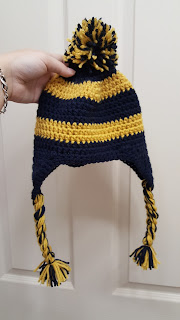


Some of these were made in 2016 and I just failed to post them. Whoops!


For this hat, instead of using the recommended yarn (which isn't available in U of M colors for purchase here in Oregon and I would have had to order it), I used two separate colors and simply switched yarn where I felt stripes should go. If anyone is truly interested I have written out the breakdown of how many rows per stripe. Just ask! My only regret is the length of the braids. I wish I'd made them longer!


These are so fun to make, and after just a few I had the pattern down and just kept cranking them out. I think they make great coasters! I also recently used them as buffet table decor at a garden party.


For the hexagon blanket, I chose to use an acrylic yarn instead of a cotton yarn (simply because we don't have a Hobby Lobby around here and I could not for the life of me find a cotton yarn at Joann's that had the same gauge as the yarn recommended in the pattern). So instead I used several colors from the Premier Yarns Deborah Norville Everyday line, which matches the gauge of the recommended yarn (and was a real pain in the butt to find, let me tell you. I spent a good 45 minutes in Joann's checking the gauge of almost every line of yarn).
Differences between my way and the original pattern:
1. The yarn recommended in the original pattern yields 7 hexagons. The yarn I used yields 10, with a bit left over for sewing. (Pro tip: I used an empty paper towel tube, cut 6 slits in each end like fringe, and then wound each yarn on the paper towel tube next to one another and stuck the ends in the notches I made, that way I didn't have to keep running back and forth between wads of messy yarn in order to stitch my pieces together at the end)
2. Original pattern uses 5 colors. When I was done with 5 colors (50 hexagons), I found that the blanket was too small, so I added a 6th color in order to keep from repurchasing 5 skeins of yarn just to get two more hexagons per skein.
3. I DID block my hexagons as recommended, but I found that acrylic yarn really doesn't need it and it was easy enough to identify the stitches I needed to put together when I laid it all out, plus my stitches are consistent enough now that the hexagons really were exactly the same size when I was done. All 60 of them. Definitely block with cotton yarn, though. Also if you decide to block with kebab skewers... Watch out for splinters. Once I learned my lesson, mine took about a week to come out.
I loved this pattern as well! This was the first pattern that I've ever paid for and even though it killed me to purchase a pattern, I have to say that it was worth it. Here are my tips for this pattern:
1. Make sure to firmly stuff the entire doll, ESPECIALLY THE HEAD. I initially tried to make the head a bit softer and squishier because this is for a baby, but I found that it didn't stretch the head to the correct size and as a result when I tried to stitch the ears on, they were enormous in comparison to the head. I had to run out and purchase more Poly-fil (I'd run out after finishing the body and actually had to stuff the middle with a lot of scrap yarn-- thank god I'm strange and keep all of the bits of yarn that I trim off when I finish anything) and then pull tufts of it through the spaces between stitches with a smaller gauge hook. That took a good few hours out of my time budget!
2. Make sure you're counting your stitches. He looks perfectly fine, but somewhere I lost a stitch... then added one to make up for it... and then somehow gained an extra stitch... and had to decrease again in order to get back to where I was meant to be. I'd forgotten how intensive amigurumi is on my arthritic hands (because auto immune diseases make me into a little old lady, lucky me!), so even though it still bothers me knowing that there are random stitches in the doll, I simply couldn't bear to take out the rows and re-do them. After 60 hexagons and a 10 inch doll, I was popping Aleve like candy.
3. I made the doll with the same exact yarn that I used for the hexagon blanket (the dark grey) and used an F sized hook (which is a different weight of yarn and a different sized hook than the pattern calls for). Not sure how that affected things overall, but I think he's a great size. As a side note, if you use the yarn and hook I used, I needed a little over one skein of yarn and had to run out to repurchase just past the hips on the body (also I crochet things out of order-- the body was the last thing I finished so I really only needed like 15 yards or so more).
4. I love the top hat, but I really wanted to incorporate the colors from the blanket into the elephant to have them match. As a result, I ditched the hat, made a single crochet chain the same number of stitches as the last row of the body, and then made an itty bitty bow with this pattern.
5. The pattern tells you to use wire for the nose, but as this was for a baby I used my common sense and ditched the wire. With amigurumi, your stitches are very, very tight most of the time and as a result you really can mold a piece with your hands (for example, one of the arms was a tiny bit shorter than the other... So I stretched it. They look perfectly equal to me!). So I was able to bend the nose myself. Also I forewent safety eyes (because despite the fact that they are called safety eyes, they are not safe to use around infants) and simply stitched little black eyes in with some spare black yarn I had. I did pop in the safety eyes just to figure out where I wanted to stitch them in and then I removed them, and I will say that safety eyes 10/10 always make everything look more professional. So if you're not giving this to a teeny tiny choking hazard, USE SAFETY EYES THEY'RE THE BEST
6. If you decide to make this blanket pattern, I would highly recommend telling me so that I could tell you how I sewed it together. It was a really stressful point for me until I read through the comments on the page that explains how to stitch the pieces together and then made up my own method, which worked really well. The only thing I had trouble with was hiding the ends, and I'm almost positive that they'll pop out of their hiding places and just be little fuzzy surprises on the back of the blanket, but there's nothing I can do about that now!
Depression
You go to bed one night, and while you don't necessarily have anything to look forward to the next day, you don't bear any ill will toward it. It should be just another day. You should be able to get up in the morning and shower, brush your teeth, wash your face, make breakfast, etc.
When you have depression, sometimes you really can't tell when it's going to hit. So sometimes, you wake up the next day and you just can't. You can't do any of it. And there's no clear reason why. It's as though someone has broken into your mind and taken you hostage.
It feels like there are two of you. One of them is the Real You, locked inside, with not enough strength to break through and override this new... Something. You don't know what it is, but it's familiar. And you hate it. This has happened before.
You end up spending the entire morning and early afternoon in bed. And you just can't. The Real You is screaming. "Get up! Get the fuck up! Get up right now, you don't have to feel like this. You can help yourself if you just GET. UP."
Sometimes, you can't get up. You will spend the entire day in that bed. You will forget to eat or drink. You will only get up to go to the bathroom once, and that's because you can't hold it forever. You will ignore all responsibilities and self care. You will spend hour after hour scrolling through the internet on your phone, begging to see something, anything, that makes you feel... Something. Anything. That thing might never come.
Other people pass you by on your various social medias. You barely absorb what's happening. The real you is desperate, banging at the bars on the windows of your mind to please, please let you out so you can join in the fun. It does look fun-- to do things, to move forward. To live life. But today, you can't do it. You care about nothing and no one. You can't even bother to care to hope that maybe tomorrow will be better.
But sometimes, the Real You wedges its way into the cracks of the bars on the windows, and you find that they're not so impossible to snap as you thought. Difficult, yes, but not impossible.
You start with getting out of bed and turning on the shower. Baby steps, you tell yourself. You get in the shower, and the routine of it sets in. You're able to complete your task with no casualties, and after that, everything seems marginally... smoother. Familiar.
You keep the ball rolling. You complete your face routine. You brush your teeth. You don't do a great job of it, but you braid your hair-- at least you did it. You pin it up, because you know that wet hair on your neck bothers you, and you can't have anything else bothering you today. You know that the progress you've made so far is fragile.
You get dressed-- in actual clothes that you can leave the house in, not just another set of PJs, nor even the PJs you took off when you got into the shower. Real, clean clothes. Clothes that you like. A favorite shirt, a comfy pair of jeans. You finally look presentable, if not entirely happy. You glance at the mirror several times but you can't look yourself in the eye-- yet.
You know you like tea, so you put the kettle on. Tea has been helping lately, on the days when it almost gets this bad. Tea will help.
The tea does help. And you're starting to feel things again. You start to notice you're hungry-- you haven't eaten for almost 24 hours. But not hungry enough yet. There is more progress to be made.
You throw open the windows-- it's a nice day for the second day in a row, after months and months of the gloom and rain of winter. You know you need the fresh air.
You already made sure that you're wearing real clothes-- a part of you was planning to go get the mail, and you didn't even notice. You're making routine decisions again-- a good sign. You walk, instead of driving, even though it's at least a quarter of a mile to the boxes. You know you need it. The Real You is getting stronger and the Something is gone now. The Real You is just undoing the damage, blowing away the fog. You know you can do this.
You walk to the mailboxes with your head down, not entirely thrilled to be outside but not hating it either. The sun feels good. You only hope that no one talks to you, because like the food, you haven't uttered a word in nearly 24 hours. You're not ready for verbal conversation. Baby steps.
You finally make it back to the house, mail in tow, and it strikes you-- you're finally hungry. You were always hungry, but now you care enough to do something about it and have the capability to do something.
You make lunch. You message a couple of friends. You pet your cat, who you notice looks very sweet in the sunlight.
Lunch is delicious. It dawns on you that you finally have wants and needs again. The fog has lifted, but the bridge you've built is still fragile. You are wary of the fog returning.
But you trek on for one more day. You won today. If it comes back tomorrow, you might not win. Sometimes the Real You is too tired of fighting to fight on that day. But maybe the next day you can do it. Maybe you can keep the ball rolling and keep doing it for several days in a row.
There's always going to be a day of weakness. Of overload. Where it's all too much. Outside forces can push you down, and you'll be fighting more than just the Something.
But today, you've won.
When you have depression, sometimes you really can't tell when it's going to hit. So sometimes, you wake up the next day and you just can't. You can't do any of it. And there's no clear reason why. It's as though someone has broken into your mind and taken you hostage.
It feels like there are two of you. One of them is the Real You, locked inside, with not enough strength to break through and override this new... Something. You don't know what it is, but it's familiar. And you hate it. This has happened before.
You end up spending the entire morning and early afternoon in bed. And you just can't. The Real You is screaming. "Get up! Get the fuck up! Get up right now, you don't have to feel like this. You can help yourself if you just GET. UP."
Sometimes, you can't get up. You will spend the entire day in that bed. You will forget to eat or drink. You will only get up to go to the bathroom once, and that's because you can't hold it forever. You will ignore all responsibilities and self care. You will spend hour after hour scrolling through the internet on your phone, begging to see something, anything, that makes you feel... Something. Anything. That thing might never come.
Other people pass you by on your various social medias. You barely absorb what's happening. The real you is desperate, banging at the bars on the windows of your mind to please, please let you out so you can join in the fun. It does look fun-- to do things, to move forward. To live life. But today, you can't do it. You care about nothing and no one. You can't even bother to care to hope that maybe tomorrow will be better.
But sometimes, the Real You wedges its way into the cracks of the bars on the windows, and you find that they're not so impossible to snap as you thought. Difficult, yes, but not impossible.
You start with getting out of bed and turning on the shower. Baby steps, you tell yourself. You get in the shower, and the routine of it sets in. You're able to complete your task with no casualties, and after that, everything seems marginally... smoother. Familiar.
You keep the ball rolling. You complete your face routine. You brush your teeth. You don't do a great job of it, but you braid your hair-- at least you did it. You pin it up, because you know that wet hair on your neck bothers you, and you can't have anything else bothering you today. You know that the progress you've made so far is fragile.
You get dressed-- in actual clothes that you can leave the house in, not just another set of PJs, nor even the PJs you took off when you got into the shower. Real, clean clothes. Clothes that you like. A favorite shirt, a comfy pair of jeans. You finally look presentable, if not entirely happy. You glance at the mirror several times but you can't look yourself in the eye-- yet.
You know you like tea, so you put the kettle on. Tea has been helping lately, on the days when it almost gets this bad. Tea will help.
The tea does help. And you're starting to feel things again. You start to notice you're hungry-- you haven't eaten for almost 24 hours. But not hungry enough yet. There is more progress to be made.
You throw open the windows-- it's a nice day for the second day in a row, after months and months of the gloom and rain of winter. You know you need the fresh air.
You already made sure that you're wearing real clothes-- a part of you was planning to go get the mail, and you didn't even notice. You're making routine decisions again-- a good sign. You walk, instead of driving, even though it's at least a quarter of a mile to the boxes. You know you need it. The Real You is getting stronger and the Something is gone now. The Real You is just undoing the damage, blowing away the fog. You know you can do this.
You walk to the mailboxes with your head down, not entirely thrilled to be outside but not hating it either. The sun feels good. You only hope that no one talks to you, because like the food, you haven't uttered a word in nearly 24 hours. You're not ready for verbal conversation. Baby steps.
You finally make it back to the house, mail in tow, and it strikes you-- you're finally hungry. You were always hungry, but now you care enough to do something about it and have the capability to do something.
You make lunch. You message a couple of friends. You pet your cat, who you notice looks very sweet in the sunlight.
Lunch is delicious. It dawns on you that you finally have wants and needs again. The fog has lifted, but the bridge you've built is still fragile. You are wary of the fog returning.
But you trek on for one more day. You won today. If it comes back tomorrow, you might not win. Sometimes the Real You is too tired of fighting to fight on that day. But maybe the next day you can do it. Maybe you can keep the ball rolling and keep doing it for several days in a row.
There's always going to be a day of weakness. Of overload. Where it's all too much. Outside forces can push you down, and you'll be fighting more than just the Something.
But today, you've won.
Friday, August 4, 2017
A Semi-Surprise Michigan Trip!
Hey guys!
In July I made a surprise trip to Michigan and I've been home for just a couple of days. I intentionally made this trip uneventful, preferring to simply hang out with family and friends in a very low-key way, so I don't have many stories to tell but I do have some photos to share!


In July I made a surprise trip to Michigan and I've been home for just a couple of days. I intentionally made this trip uneventful, preferring to simply hang out with family and friends in a very low-key way, so I don't have many stories to tell but I do have some photos to share!

Christina, Jackie, and Ella modeling their little purses that I crocheted for them

Ella opening her birthday gift from us

Ella and Lady, the neighbors' dog

Me and Babcia at bingo!

The girls fell asleep on the way home

Babcia, 97, enjoying a fidget spinner


The coolest domesticated wolves in Redford


Gotta get my Timmy's!

Arbok

Sweet Kayla!

Copper aka Houdini aka Hammy
See you next time, Michigan!
Sunday, July 16, 2017
Mini Mail Sack Purse by Pink Chalk
Hey y'all! There won't be a whole lot to this post other than sharing another purse I made with the Mail Sack Purse pattern by Pink Chalk.
When I was 13, I had a very lightweight fabric purse from Target that I absolutely loved, and I called it The Magical Bag of Fruit. It was magical because even at 13, I was Brook "Always Prepared" Gasser (coined by Austin Evans circa 2012), and I had absolutely everything in it. It was like the Barney Bag-- filled with anything you could possibly need. I even used to carry scissors (and I still do... except now they're thankfully part of a Swiss Army Knife and take up much less room).
After a trip to Joann's recently, I found some fantastic food-based fabrics and I knew I had to make another Magical Bag of Fruit. For once I didn't go crazy with the customization-- I only lengthened the strap because I prefer cross-body bags and I tweaked the zipper step that is a part of the Large pattern (there is no zipper step in the Mini pattern-- I have no idea why, it wasn't that difficult to incorporate on my own).
So here's the finished product! My Strawberry/Lemon purse! Strawberry Lemonade, anyone?


When I was 13, I had a very lightweight fabric purse from Target that I absolutely loved, and I called it The Magical Bag of Fruit. It was magical because even at 13, I was Brook "Always Prepared" Gasser (coined by Austin Evans circa 2012), and I had absolutely everything in it. It was like the Barney Bag-- filled with anything you could possibly need. I even used to carry scissors (and I still do... except now they're thankfully part of a Swiss Army Knife and take up much less room).
After a trip to Joann's recently, I found some fantastic food-based fabrics and I knew I had to make another Magical Bag of Fruit. For once I didn't go crazy with the customization-- I only lengthened the strap because I prefer cross-body bags and I tweaked the zipper step that is a part of the Large pattern (there is no zipper step in the Mini pattern-- I have no idea why, it wasn't that difficult to incorporate on my own).
So here's the finished product! My Strawberry/Lemon purse! Strawberry Lemonade, anyone?


Here you can see the regular "divided pocket" that the pattern includes and my additional zipper pocket. I simply used a 7 inch zipper and adjusted the directions accordingly.
Friday, May 19, 2017
S.E. Hinton Q&A At Powell's Books
I was still in elementary school, several years before I was assigned The Outsiders to read in school (I happened to read it in the 8th grade), when I discovered Tex on the bookshelf at my grandparents' house. I often used to "check out" books from their collection; I picked it out as soon as my grandmother had told me that it had been my father's. Wanting to connect with him through that book, I took it home and eventually had "checked out" the book so frequently that it simply never left my bookshelf at home. That was over fifteen years ago, and it's made it all the way across the country with me (along with other books written by S.E. Hinton, several of which I own multiple copies of).
Fast forward to 2017, and I've got half of an entire bookshelf dedicated to S.E. Hinton. First I fell in love with Tex, which I still re-read every few years, and then The Outsiders, through which I discovered another of my favorites, That was Then, This is Now, and her most recent work Hawkes Harbor. Although there are other books that I'll read more frequently, I credit Tex for inciting my love for novels (and old, worn out books). There's not a single book of Hinton's that I don't love, and for this reason she beats even JK Rowling as my favorite author.
Earlier this week, Patrick announced to me that she would be doing a Q&A and book signing at our local Powell's book store. Today I was blessed enough to attend (and even somehow worked up the nerve to ask her a question-- can you guess which?), after which she signed that beaten old copy of Tex and my beloved copy of Hawkes Harbor. Several months ago I purchased a signed copy of the 50th anniversary edition of The Outsiders, so I've got that as well.


The following text is a transcription from S.E. Hinton's Q&A at Powell's Books (Cedar Hills) for the 50th anniversary of her novel The Outsiders on May 18, 2017.
Fast forward to 2017, and I've got half of an entire bookshelf dedicated to S.E. Hinton. First I fell in love with Tex, which I still re-read every few years, and then The Outsiders, through which I discovered another of my favorites, That was Then, This is Now, and her most recent work Hawkes Harbor. Although there are other books that I'll read more frequently, I credit Tex for inciting my love for novels (and old, worn out books). There's not a single book of Hinton's that I don't love, and for this reason she beats even JK Rowling as my favorite author.
Earlier this week, Patrick announced to me that she would be doing a Q&A and book signing at our local Powell's book store. Today I was blessed enough to attend (and even somehow worked up the nerve to ask her a question-- can you guess which?), after which she signed that beaten old copy of Tex and my beloved copy of Hawkes Harbor. Several months ago I purchased a signed copy of the 50th anniversary edition of The Outsiders, so I've got that as well.


The following text is a transcription from S.E. Hinton's Q&A at Powell's Books (Cedar Hills) for the 50th anniversary of her novel The Outsiders on May 18, 2017.
Hinton: I never know what you all want to hear, so I’m going to open this up to questions so I will know at least one person has interest in what I’m saying… and young people, don’t feel silly asking me a question. You couldn’t possibly feel sillier than I do standing up here answering them.
I’m an English teacher and I’ve taught your book for years. It’s one of those stories that the kids just really latch onto. I know you wrote it when you were a teenager; was it an assignment?
Oh no. Not only was it not an assignment, I made a ‘D’ in creative writing while I was writing it. I’d been writing for years and it was something I wanted to write. Somebody just recently on this tour said, “Oh, weren’t you devastated when she gave you a ‘D’?” and I said, “No, I thought ‘Woman you’re gonna feel like an idiot,’” because I’d always known I wanted to be a writer. I hate that that’s my most known teacher story, because I had really good English teachers that encouraged me a lot throughout my whole history. But I found out that publishers will correct your spelling. They’re not going to can it off, give you a “D”, because you didn’t spell something right.
Where did you get the idea for Ponyboy?
I can’t remember where I got the name, but he’s the character that’s most superficially like me in that he’s very much like I was at 14. I’ve learned as a writer, no matter who you think you’re basing your character on, they’re part you because you’re the filter. All of your characters have to go through you to come out on the page. I don’t care if you think you’re basing it on your best friend; unless you can mind meld with your best friend, that’s some part of you. So while Ponyboy was most like me, there’s some part of me was Dallas, or I wouldn’t have been able to write him.
I was wondering if you could talk a little about harnessing first person voice for each of [your] different books.
First person voice is actually the easiest for me. It’s the easiest and also the hardest in that it’s very emotionally involving for me. I’ve been around enough acting to know that I can compare it to acting. The actor knows his part—he knows the whole screenplay, but he can’t act like he knows the whole screenplay. He’s got to be that person, and of course I’ve got a pretty good idea what the whole book’s going to be like, but I have to be the person I’m writing from. I think if you read my young adult books you’re not going to mistake Tex’s voice for Rusty James’s voice. They all have their own voice. To me that’s one of the fun parts of writing—be somebody else, go somewhere else, do something. I’m not one of those people who will ever write some woman having a midlife crisis and she runs off with the gardener. I mean, why would I want to do that? I want to write something like Hawkes Harbor where I can smuggle jewels out of Burma and run guns for the IRA and do all of this other stuff—to me that’s the fun part of writing. It’s not limiting to your life and not writing about yourself, but getting the habit of other people. That’s one of the big things I learned about reading—I started writing in grade school because I read a lot, and I realized you can be anywhere you want to be. You can bungee jump into the future; you can visit the past. That is the joy of reading, and to me it’s a lot of the joy of writing too.
On the movie set of The Outsiders were you able to help the actors and directors to kind of get it right, like your vision?
I was there every day, and Francis [Coppola] gave me total leeway to help with the actors if I wanted to. He was having a lot of problems financially and he’d go, “Go run lines with the boys and see what’s going on,” so I had a lot of input for them... but they were all so good, I mean, they read the book. They knew what was called for. But I did get to help. The place I helped them most… they were little kids, they were turned loose in Tulsa with no adult supervision whatsoever. Tommy [Howell], that played Ponyboy, was 15. Rob [Lowe] had his 18th birthday on the set. Matt [Dillon] had just turned 18. These were little kids, so I immediately decided I was their mom, and like mothers everywhere I slapped them upside the head once in awhile. I didn’t want to know what was going in the hotel so I stayed out of the hotel… That’s one thing you learn as a mom; there are just some things you don’t want to know. But they remembered that, and I’m very close to all of them still. I just saw Tommy, and Darren Dalton who played the Soc Randy, and Ralph [Macchio]. Last month Rob Lowe came to town; he had his 18th birthday on the set, and he had his 53rd at The Outsiders house location. That was a lot of fun.
Where did you get the idea for the line “stay gold”?
That Robert Frost poem was something I read during the time I was writing the book, and I thought, “This is something like I’m trying to say in the book.” I couldn’t figure it out exactly, couldn’t put my finger on it, but I thought, “Yeah, I need this in the book.” So I went home and wrote the Robert Frost poem into the book. Then later when Johnny is dying and he says, “stay gold”... Ponyboy had talked about the poem, and Johnny had said, you know, it means try to stay as idealistic as you can. So that was where I got the idea for “stay gold”. I wish I had trademarked that. I’ve seen it on greeting cards: “stay gold.” And I’m going, “Where’s my royalty?”. But it’s nice to be known for that phrase because it’s a good phrase.
Is the reason you gave Cherry green eyes because Pony didn’t like people with green eyes?
That’s a thing because maybe Ponyboy didn’t like himself. You know, when you’re a teenager there’s a lot of things about yourself you don’t care for. I think it helped him realize—because they both had green eyes and they both looked at the sunsets at night—and it helped them cross the boundaries to an understanding. So I think that’s why, but believe me, when I was writing the book I had no idea what I was writing. I’ve only figured out this stuff years later when people have written me letters and told me what I was writing.
I have a new Mustang, do you still think they’re “tuff” cars?
Oh, I think they’re so tuff. I think they’re just cool. But since I’ve started watching Supernatural... [‘67 Impala], whatever they drive… I love that car.
What was it like to see your book get turned into a movie?
It was really great. Francis came into town and he wanted me to drive around the locations I was thinking about—which I did, I took a drive through the neighborhoods. He said, “Well, I think I’ll shoot it here Susie, you wanna help me?” and I said, “Yeah, I’ll be fine with that.” He and I wrote the screenplay together, we scouted locations together. One day I was working with Francis on the screenplay and he said, “Oh, we found the house we want to use for The Outsiders house, you wanna see it? I’ve got my bike outside.” And I said, “Sure,” so I go out there... He’s got this old, thick-tired bicycle and he wants me to sit on the bars! He’s got 60 pounds of camera equipment in the basket and he drove me over just a few blocks—where the house was—but believe me it was a treacherous ride. The prop man came by, jumped out, and took a picture of it... it’s really nice. I have it in my office and Francis has it in his.
So few writers will ever have 50 years growing up with a book; I’m wondering if you think of it as a sibling or a child.
50 year anniversary... I don’t like touring, it’s hard on me. I don’t like travelling. I don’t like speaking until I get up here and I realize no one’s going to attack me. But I mean, how many writers get to see the 50th anniversary of any book, especially one like The Outsiders which sold last year better than it’s ever sold? That’s why I’m here today.
When you start writing do you find that you start with a character or a plot first?
Oh, I always start with a character first. I can’t plot my way to a Safeway store. I know the beginning is easy for me because I get to establish my character, or characters, and their background and everything, and the ending—I’ve always known what the ending is for my book, and I could write the last sentence first. But how I get from here [indicates] to here [indicates], I go [demonstrates with index finger moving around in an unpredictable pattern] over here, so the plot is the hardest for me. I know my strengths. My strength is characters and revelation in characters through dialogue, which is why I love writing screenplays. But if I had to write a car chase, I’d go: “Okay the car went over here, and it flipped, and there’s another car, and it flipped…” So I like to play to my strengths.
Why did you use the story Gone With the Wind instead of any other war story?
I don’t know, I was reading it probably. Believe me, I wasn’t thinking about anything when I was writing that book. People are going, “Oh, you did this religious symbolism.”... Oh, I did? And I was reading Gone With the Wind, so I stuck in Gone With the Wind. When I was in high school, some kid dissected his worm in biology with his switch blade, so I thought: “Oh that’s great, I’ll go home and write that in.” People are going, “Is this intentional?” I’m beginning to think nothing is intentional. I just kept writing it. But your subconscious plays such a big part in your writing that I used to think maybe I could take a nap and wake up to find a chapter done. That happened with Hawkes Harbor. I woke up from a dream; I dreamed that I was on the ship that was smuggling gems and Kel Quinn, this Irish story teller, was telling this great story. I woke up laughing and I thought, “I’ll go with him!” That’s definitely subconscious. It’s hard to tell, especially for me, where things really come from.
Did you have any part in helping cast the incredible lineup for your movie?
No, the only part I had in casting the movie was I strongly recommended Matt for Francis because I worked with [Matt] on Tex. Tex was my first movie, and that’s where I met Matt. They didn’t seem to be looking at him, and I finally just asked Francis and the casting director. I thought maybe it was because [Matt] just did a movie with me. I said, “Please look at Matt for Dallas. He’s a whole lot more suited to play Dallas than he was Tex, and he did a great job in Tex.” So they did look, and Francis decided he was perfect.
I’d love to hear the story of how [The Outsiders] came to be published when you were so young!
I’d been writing for eight years. It was the third book I’d written, the first I’d tried to get published. It was just in my drawer in my closet with stacks and stacks and stacks of stuff. A friend of mine at school mentioned that her mother wrote children’s books and I said, “Oh, I write books,” and she said, “Let my mother read it,” and she did. [Her mother] gave it to a friend of hers who not only was published—she had an agent. She gave me the name of an agent. I was a junior in high school; I didn’t know the difference between agent and editor and publisher. But I had a name and an address so I sent it to [Marilyn Marlow of Curtis Brown Limited]. She wrote back and said, “I think you’ve captured a certain spirit here, I’ll see what I can do.” She sold it to the second publisher who saw it. Marilyn remained my agent until she just died like fifteen years ago, and I’m still with Curtis Brown. When kids write me and go, “Well, how do you get an agent?” I go, “Google it!”, because God sent me my agent, and I don’t think it’s a good idea for you to wait around for God to send you your agent. That’s what happened to me.
Subscribe to:
Posts (Atom)